
Choosing a Contactor: AC-1 or AC-3, and How to Read the Rating
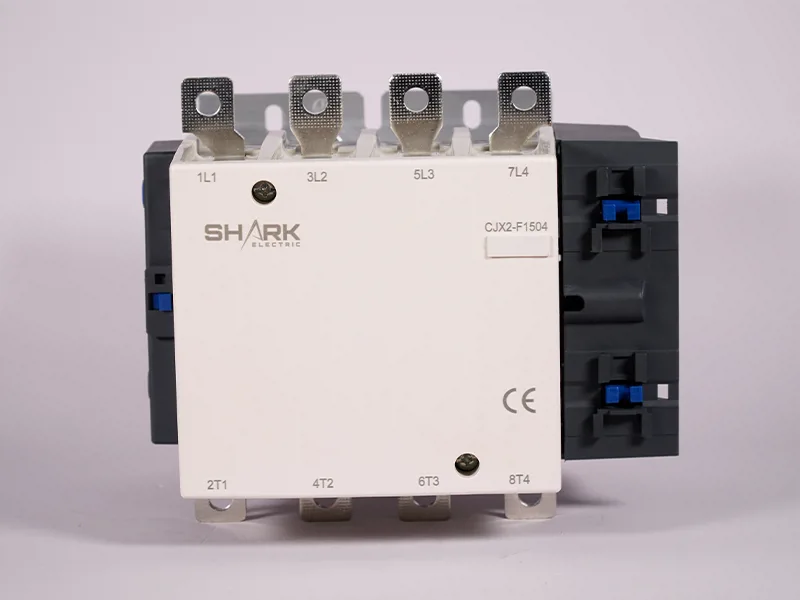
The same contactor appears in a catalogue with two different current ratings. We explain utilisation categories, sizing by motor power and the pole count decision.
The most common mistake when choosing a contactor is to read the largest ampere figure in the catalogue. The same device may be declared at 95 A in category AC-1 and 45 A in category AC-3. Correct selection starts by identifying the type of load and then reading the current for that category.
- For heating, resistive or distribution loads, read the AC-1 column.
- For an induction motor, read the AC-3 column; the contactor must also withstand the starting current.
- For frequent starting or plug braking, the AC-4 figures apply and the device is sized up.
- A contactor alone does not protect a motor; it needs a thermal overload relay beside it.
What a utilisation category tells you
The utilisation category defines what kind of load the contactor switches and under what conditions. IEC 60947-4-1 standardises these categories. What determines a contactor life is less the current it carries than the moment at which it opens and closes.
| Category | Load type | Switching condition | Typical application |
|---|---|---|---|
| AC-1 | Resistive or slightly inductive | Make and break at rated current | Heaters, resistive loads, distribution feeders |
| AC-3 | Squirrel-cage induction motor | Make at starting current, break at rated current | Pumps, fans, compressors, conveyors |
| AC-4 | Induction motor, severe duty | Make and break at starting current | Cranes, lifts, machines with frequent starts |
Why does one product show two currents?
A motor draws five to seven times its rated current while starting. In category AC-3 the contactor must close onto that current; in AC-1 no such load exists. The same contact set is therefore declared at a lower current for motor duty.
In practice: the large number on the label is usually the AC-1 figure. If you are feeding a motor, that number is not the one you need.
From motor power to contactor
Catalogues also state the motor power a contactor can control at each voltage. On a 380/400 V supply, finding the row that matches the motor nameplate power is the most practical route. If the motor rated current is known, choose the first contactor whose AC-3 rated operational current exceeds it.
Three poles or four?
Three poles are enough for three-phase motor control. Four-pole versions are used in distribution applications where the neutral must be switched too, and where four-pole isolation is required. Four-pole contactors are usually declared with AC-1 values, that is, for distribution loads.
Coil voltage and what goes beside it
The coil is chosen to match your control circuit: 24, 48, 110, 220, 380 and 415 V AC plus 110 and 220 V DC are common options. If a coil fails, a replacement coil can be fitted instead of changing the whole contactor.
- Thermal overload relay: protects the motor against overload and phase loss. With the contactor it forms a magnetic motor starter.
- Auxiliary contact block: adds contacts for sealing, interlocking and signalling circuits. A typical arrangement is 1 NO + 1 NC.
- Mechanical interlock: physically prevents two contactors from closing together, essential in reversing, star-delta and mains-generator circuits.
Frequently asked questions
Does a contactor protect a motor against overload?
No. A contactor is a switching device, not a protective one. A thermal overload relay must be added for overload protection.
Can a contactor rated for AC-3 be used in AC-4 duty?
It should not. In AC-4 duty the contactor both makes and breaks at starting current and the contacts erode far faster. Such applications call for the next size up.
Are mechanical and electrical life the same thing?
No. Mechanical life is the number of operations without load and is very high. Electrical life is the number of operations under load and falls markedly depending on the utilisation category.
Can the coil voltage be changed later?
Yes. Replacement coils are available in different voltages within the same series, so a contactor can be adapted to another control voltage.
This article is for information. Protection and control design for a motor circuit is the responsibility of the qualified electrical engineer for the project.