
What an Automatic Transfer Switch Does and How to Size One
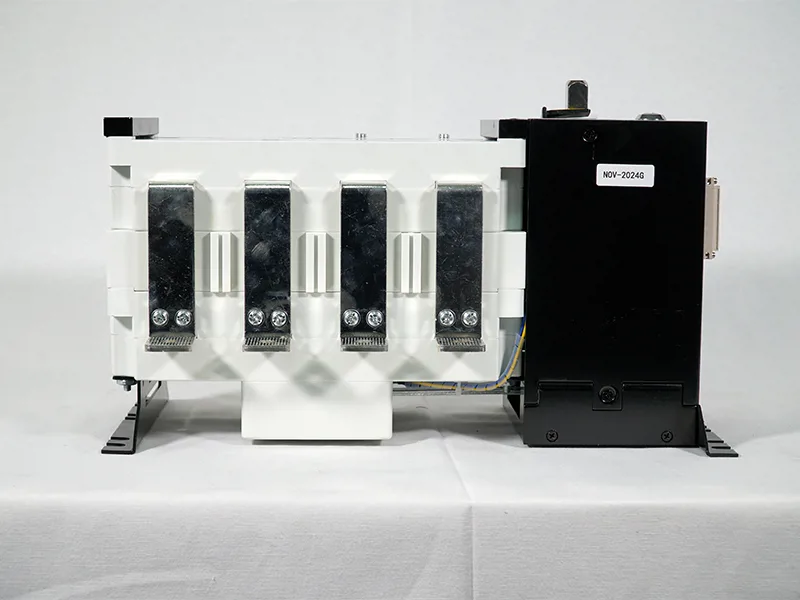
What an ATS does, why the mechanical interlock is critical, and how to choose rated current and pole count for an installation with a generator.
An automatic transfer switch is an electromechanical disconnector that moves the load between two supplies on its own. When the mains fails it transfers the load to the generator, and back again when the mains returns. Its most critical property is not speed but the fact that the two sources can never be connected at the same time.
- An ATS transfers between mains and generator automatically and, thanks to its mechanical interlock, never bridges the two.
- Rated current is chosen from the total load being transferred, not from the generator rating.
- Because the neutral usually has to be transferred as well, installations with a generator typically use a 4-pole device.
- The governing standard is IEC 60947-6-1, which distinguishes class PC and class CB devices.
Why the mechanical interlock matters so much
Paralleling the mains and a generator even for an instant, without synchronisation, causes severe damage and creates a safety hazard. Equally, back-feeding generator power into the mains during an outage is potentially fatal for anyone working on the network.
For that reason a transfer switch contains a mechanical interlock that physically prevents the second source from closing while the first is live. That protection does not depend on the control circuit and holds even if the controller fails.
Choosing the rated current
A transfer switch must carry the entire load continuously, so it is selected from the current of the load being transferred, usually rounding up to the next standard size.
A common error is to size the ATS from the generator rating. The generator is only one of the two sources; in normal operation the switch carries the mains load as well.
| Decision | What determines it |
|---|---|
| Rated current (In) | Continuous current of the total transferred load |
| Number of poles | Four if the neutral must be transferred |
| Rated voltage (Ue) | Installation voltage, typically AC 400 V |
| Control | Manual, automatic or both |
| Transfer time | The interruption the load can tolerate |
| Standard | IEC 60947-6-1 |
Why four poles?
A generator has its own neutral-earth connection. If the neutral is not transferred, the neutrals of both sources stay tied together, which can cause circulating currents and false operation of earth-leakage protection. A four-pole transfer switch is therefore the usual solution where a generator is present.
Class PC and class CB
IEC 60947-6-1 separates transfer switching equipment into two classes. Class PC devices can carry but not interrupt short-circuit currents; protection comes from the upstream device. Class CB devices incorporate circuit breakers and clear faults themselves. If your board already has a main breaker, a class PC solution is often the more economical route.
What else the panel needs
- Pilot lights showing mains and generator status: green for power present, red for fault, amber for warning.
- A buzzer for audible alarm on fault.
- A mushroom-head emergency stop to cut power in an emergency.
- Auxiliary contact blocks and relays to build the control and signalling circuits.
Frequently asked questions
Does the transfer switch start the generator?
The controller can be set up to send a start signal when it detects a mains failure. Cranking and warm-up belong to the generator control panel; the transfer switch moves the load once the generator is ready.
Is the load returned to the mains immediately?
Usually not. A delay confirms the mains is stable, then the load is transferred back and the generator stops after its cooling period.
Why is manual control needed?
To transfer between sources in a controlled way during maintenance and testing, and to keep the installation supplied if the controller itself fails.
Could two contactors with a mechanical interlock replace an ATS?
It is done at small ratings, but it does not give the same assurance as a device built for the job in terms of continuous current, short-circuit withstand and transfer mechanism.
This article is for information. Selecting a transfer switch and connecting a generator remain the responsibility of the qualified electrical engineer for the project.