
Icu, Ics, Icm and Icw: Reading the kA Figures on a Breaker Label
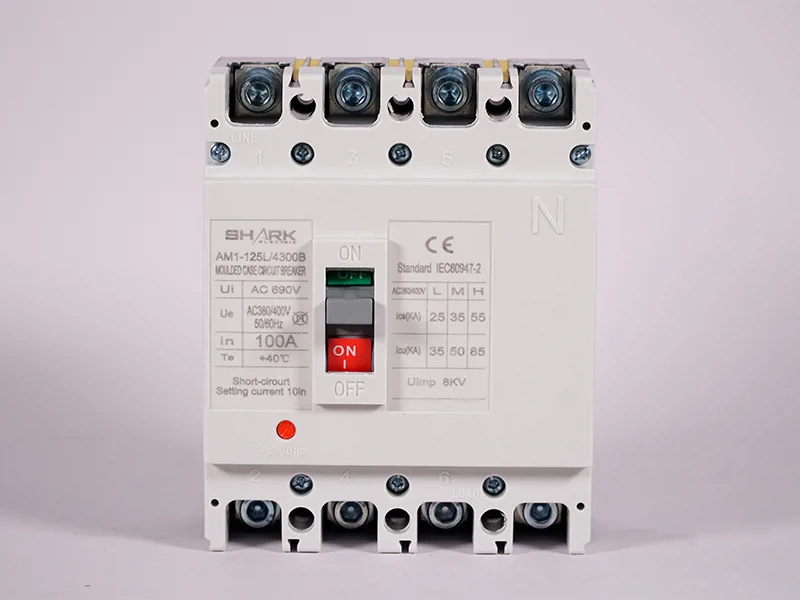
The four abbreviations on a circuit breaker label describe different things. Here is what each one means and which one governs your selection.
A circuit breaker label carries more than one kA figure, and they are not interchangeable. Icu is the largest short-circuit current the device can interrupt once, Ics the current after which it can stay in service, Icm the peak current it can close onto, and Icw the current it can carry without tripping.
- Icu: rated ultimate short-circuit breaking capacity. It sets the floor: Icu must exceed the prospective short-circuit current at the point of installation.
- Ics: rated service short-circuit breaking capacity. It governs continuity after an interruption and is given as a percentage of Icu.
- Icm: rated short-circuit making capacity, a peak value related to Icu.
- Icw: rated short-time withstand current, the basis of discrimination, normally stated for air circuit breakers.
Four abbreviations, four different questions
| Symbol | Name | Question it answers |
|---|---|---|
| Icu | Rated ultimate short-circuit breaking capacity | What is the largest fault current this device can interrupt? |
| Ics | Rated service short-circuit breaking capacity | Can it remain in service afterwards, and up to what current? |
| Icm | Rated short-circuit making capacity | Can it close onto an existing short circuit? |
| Icw | Rated short-time withstand current | Can it hold without tripping until the downstream device clears? |
Why the gap between Icu and Ics matters
Icu is the maximum the device can manage once. After such an interruption the contacts may be badly eroded, and the standard does not require the breaker to keep working afterwards.
Ics is the current after which the breaker can remain in service, and it is declared as 25, 50, 75 or 100 per cent of Icu. In installations where continuity matters, this is the figure to check.
An example from a real label
On the AM1-125L/4300B moulded case breaker in our catalogue, breaking capacities are given separately for classes L, M and H. In class L at AC 380/400 V the label reads Icu 35 kA and Ics 25 kA, with a rated insulation voltage of AC 690 V and a rated impulse withstand voltage of 8 kV.
Those letters L, M and H denote the breaking capacity class, not the frame. The same frame can be produced in several classes, which is why ordering on the ampere rating alone is misleading.
Which figure governs the selection?
The basic rule: the breaker Icu must exceed the prospective short-circuit current at the point of installation. That current depends on the rating and impedance of the supplying transformer, on cable cross-section and on distance, and it comes out of the project calculation.
Then comes the second question: must this device remain in service after clearing a fault? If the answer is yes, Ics must also exceed that current.
Short-time withstand and discrimination
Icw is the current a device can carry without tripping for a defined time, typically between 0.05 and 1 second. It buys the downstream device the time it needs to clear the fault and so keeps the main breaker closed. It is declared for utilisation category B devices, which is where air circuit breakers sit.
Frequently asked questions
Is a higher kA rating always better?
No. Breaking capacity beyond what the installation can produce adds cost without benefit. Choose the class above the calculated fault current and stop there.
Why can Ics be lower than Icu?
Because they represent different test sequences. The breaker is not expected to remain serviceable after the Icu test, but it is after the Ics test, which is why Ics is usually a percentage of Icu.
What do L, M and H mean on the label?
They indicate the breaking capacity class. The same rated current in a different class gives different Icu and Ics figures.
When do I need to check Icm?
Whenever the device may be closed onto a live fault, for example in automatic reclosing or transfer schemes.
This article is for information. Calculating the prospective short-circuit current and selecting devices remain the responsibility of the qualified electrical engineer for the project.