
Air Circuit Breaker or Moulded Case Breaker? A Selection Guide
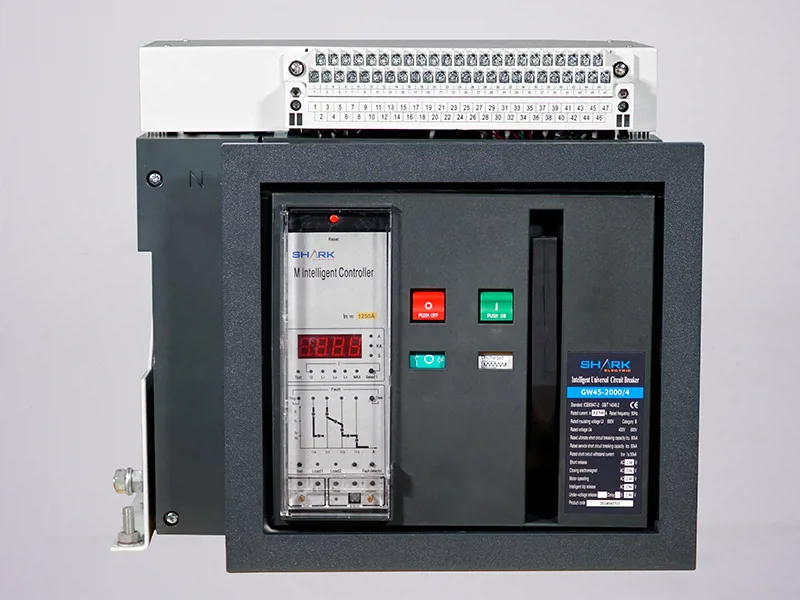
We compare ACBs and MCCBs on rated current, breaking capacity, short-time withstand and discrimination so you can pick the right main device.
In short: an air circuit breaker (ACB) belongs at the incomer of a distribution board, particularly at 1000 A and above, while a moulded case circuit breaker (MCCB) up to 1600 A suits outgoing ways and motor circuits. The decision rarely ends with the current rating though. Short-time withstand, discrimination and maintainability usually decide it.
- Incomer, generator incomer and bus coupler: air circuit breaker.
- Outgoing ways and motor circuits: moulded case breaker.
- If you need discrimination with downstream devices, you need an ACB with a stated short-time withstand current (Icw).
- Where downtime is expensive, a draw-out version turns maintenance into a matter of minutes.
Both are circuit breakers, so where is the difference?
Both devices clear overload and short-circuit currents and both are built to IEC 60947-2. The difference lies in the job they were designed for.
A moulded case breaker is a compact, economical device housed in a closed moulded body. An air circuit breaker is built to carry larger currents, to hold a short-circuit current for a defined time without tripping, and to be maintained rather than replaced.
Comparison table
| Property | Air circuit breaker (ACB) | Moulded case breaker (MCCB) |
|---|---|---|
| Typical rated current | 1000-3200 A | 40-1600 A |
| Standard | TS EN / IEC 60947-2 | IEC 60947-2 |
| Utilisation category | Usually B | Usually A |
| Short-time withstand (Icw) | Stated, the basis of discrimination | Mostly not stated |
| Trip unit | Electronic, wide adjustment range | Thermal + magnetic, fixed or limited adjustment |
| Mounting | Fixed or draw-out | Fixed |
| Maintenance | Contacts and mechanism can be replaced | Usually replaced as a unit |
| Remote operation | Motorised charging is a standard option | Possible with accessories |
| Typical position | Incomer, generator incomer, coupler | Outgoing way, motor circuit |
The value that drives discrimination: Icw
When a fault occurs, only the faulty branch should trip while the main device stays closed. That is discrimination, and it requires the upstream device to carry the fault current without tripping long enough for the downstream device to clear it.
That ability is the rated short-time withstand current (Icw), and it is typically stated only for utilisation category B devices, which in practice means air circuit breakers. With moulded case breakers, discrimination is achieved mainly through current grading and only within limits.
Fixed or draw-out?
A fixed version costs less and is enough where the breaker never has to leave its position. In a draw-out version the breaker separates from its cradle, so it can be withdrawn for maintenance or replacement without touching the busbars. Where an outage carries a real cost, that difference pays for itself quickly.
So which one, and when?
- Transformer outgoing or generator incomer: air circuit breaker, for high current and discrimination.
- Floor board, machine panel, motor outgoing: moulded case breaker, compact and economical.
- The 630-1600 A grey zone: either can work. Choose the ACB if discrimination or maintenance matters, the MCCB if space and cost lead.
The Shark Electric range
Our air circuit breakers run from 1000 A to 3200 A in 3- and 4-pole, fixed or draw-out versions with an intelligent trip unit. Our moulded case breakers cover 40 A to 1600 A with thermal and magnetic protection. Detailed figures for both are on the specification tables of each product page.
Frequently asked questions
Can an ACB and MCCBs be used in the same board?
Yes, and that is the most common arrangement: an air circuit breaker at the incomer with moulded case breakers on the outgoing ways, with protection graded in that order.
Would you ever use an ACB below 1000 A?
Yes. Even at lower currents, an air circuit breaker is chosen when discrimination, motorised operation or a draw-out construction is required.
Is discrimination impossible with moulded case breakers?
Not impossible, but limited. With enough separation between rated currents and by following the manufacturer discrimination tables, discrimination can be achieved up to a given fault level, but without the flexibility a stated Icw provides.
How do you decide on three or four poles?
Use four poles where the neutral must also be switched or monitored, and three poles where the neutral stays permanently connected to its bar. In installations with a generator the neutral usually has to be switched.
This article is for information. Which device suits a given installation depends on the calculated prospective short-circuit current and on the assessment of the qualified electrical engineer responsible for the project.